



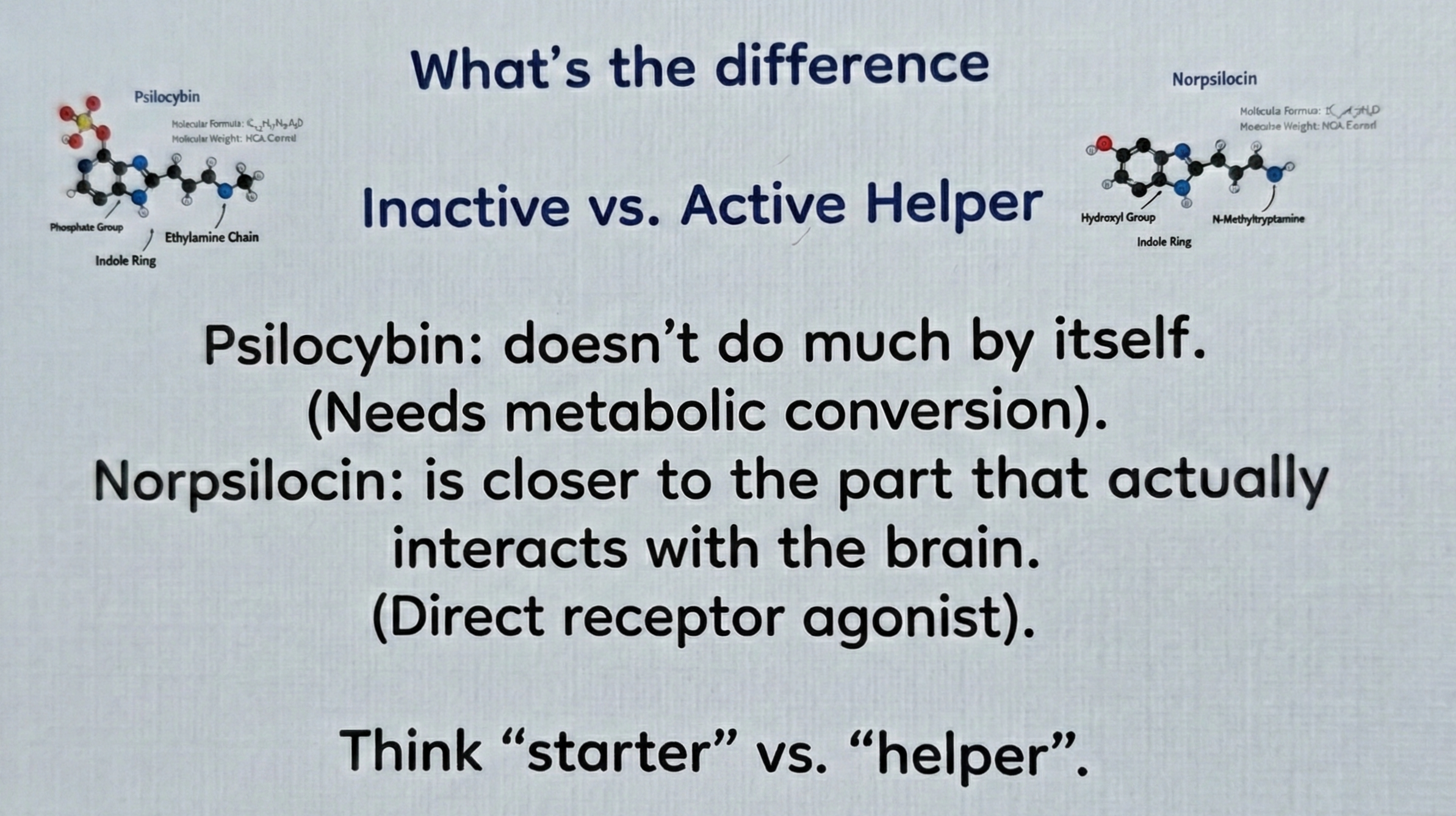


The Low-Down: Psilocybin vs. Norpsilocin
Psilocybin is the famous precursor compound found in magic mushrooms. Once consumed, your body breaks it down into psilocin, the active chemical responsible for the classic psychedelic trip. Psilocin easily crosses the blood-brain barrier and strongly activates the 5-HT2A serotonin receptors, leading to the profound sensory, emotional, and mystical experiences associated with psychedelics. Because of its powerful psychoactive properties, it is currently the heavy hitter in psychiatric research, showing massive potential for resetting neural pathways in patients with treatment-resistant conditions.
Norpsilocin is a more recently understood, naturally occurring cousin. It is primarily the active metabolite of baeocystin, another tryptamine compound found in the exact same mushrooms. In a laboratory setting, norpsilocin binds to those same 5-HT2A serotonin receptors with even greater potency than psilocin. However, due to a slight structural difference in its amine group, it does not trigger centrally mediated psychedelic effects in vivo. Simply put, it does not make you trip. Researchers are highly interested in norpsilocin because it may offer mood-boosting or anti-depressive benefits without the intense hallucinogenic journey.
Current 2026 Medical Trials & Research Focus
The clinical landscape in 2026 is heavily dominated by advanced trials on synthetic and deuterated psilocybin formulas (such as COMP360 and HLP003), which are currently navigating Phase 3 trials for FDA approval. Studies are broadly testing its efficacy for Treatment-Resistant Depression (TRD), Generalized Anxiety Disorder, and PTSD.
Research into norpsilocin and baeocystin is heavily focused on preclinical pharmacology. Scientists are synthesizing norpsilocin analogs to understand the "entourage effect" of whole-mushroom extracts versus synthetic isolates, testing whether these non-psychoactive tryptamines contribute to long-term neural plasticity.
For the most up-to-date, actively recruiting clinical trials, you can reference the following clinical trackers:
Psilocybin-Assisted Therapy in Treatment-Resistant Depression (Phase 2/3) This ongoing study evaluates the efficacy of one versus two treatments of psilocybin-assisted therapy, tracking symptom relief over a 12-month period. https://clinicaltrials.gov/study/NCT06303739
Mindfulness-Assisted Psychedelic Therapy This trial investigates whether integrating 8 weeks of mindfulness training with a psilocybin dose enhances the therapeutic outcomes for mental health. https://clinicaltrials.gov/study/NCT06233344
UCSF Psilocybin Clinical Trials Hub The University of California, San Francisco maintains an active roster of trials testing psilocybin for chronic conditions, including low back pain, Parkinson's disease depression, and anorexia nervosa. https://clinicaltrials.ucsf.edu/psilocybin
ADD & SHARE US ON SOCIAL MEDIA

Contact Us
For more information or to sign up for updates.